


Headcollar vs harness: which is safer for your dog?

Someone at the park told you to try a harness. Your vet mentioned a headcollar. The internet says both are dangerous and neither works. If you own a dog that pulls, you've almost certainly been handed contradictory advice from every direction, and the stakes feel real: you don't want to hurt your dog, but you also can't carry on being dragged down the street.
When it comes to the headcollar vs harness debate, which is safer? The good news is that this decision isn't as complicated as the online arguments make it seem. The answer depends on your dog's anatomy, health history, and how well either device fits.
At Canny, we've spent over two decades developing dog walking equipment with one principle at the centre of every design: the training tool should help the dog without harming it. That means understanding not just which device feels easier to use, but also what happens inside a dog's body when force travels through it.
This article breaks down the key differences between headcollars and harnesses. You'll learn how each works, their pros and cons for pulling dogs, and which option might suit your situation best.
Headcollar vs harness, how each device controls a pulling dog
Before you can weigh up safety, you need to understand what each device actually does to your dog's body when tension hits the lead. Both tools work by redirecting force, but they do it in very different places.
Headcollars: force through the neck and muzzle
A headcollar fits around the neck, behind the ears and around the muzzle. The lead attaches either behind the head or beneath the chin. When your dog lunges or pulls forward, a good headcollar should apply gentle pressure to the muzzle to redirect your dog's attention when they surge forward.
The lead should then loosen the second your dog stops pulling. If tension is maintained around your dog’s face, he will continue to pull and learn nothing.
"You will never walk a dog well on a tight lead"
This biomechanical advantage means you don't need brute strength to regain control. A good headcollar should work with your dog's natural body mechanics, not against them.
The problem with many traditional designs, including the widely-used ‘Halti’ style, is that the redirection happens laterally: the muzzle gets pulled sideways. That sideways torque on the cervical vertebrae is a significant biomechanical concern, particularly during a sudden, strong lunge.
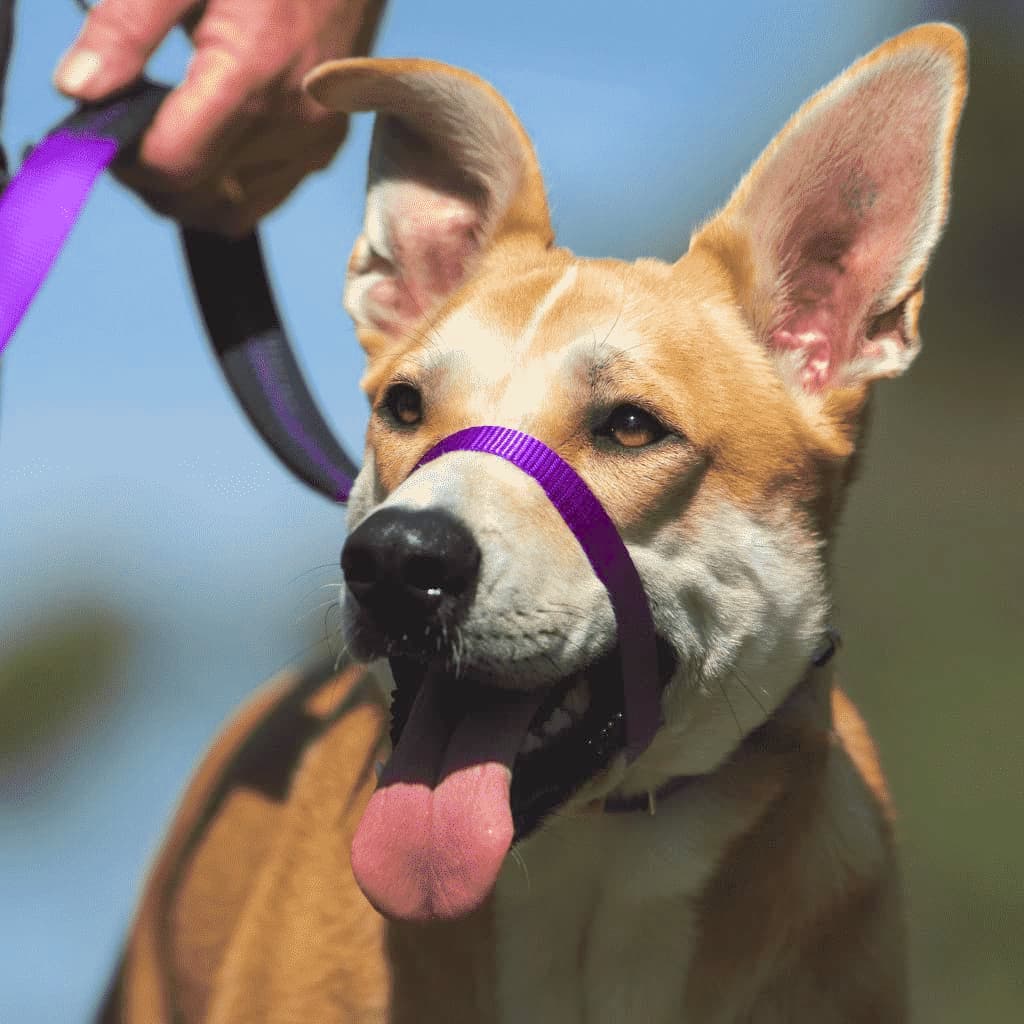
The force isn't gentle, and the neck isn't ideally positioned to absorb it from that angle. If you want a primer on conventional head-collar designs and how they work in training, see our guide on what is a dog headcollar.
Harnesses: tension across the chest and shoulders
A harness moves the attachment point away from the neck entirely and spreads the pulling force across your dog's chest, shoulders, and back. But harnesses aren't identical: a back-clip design attaches at the spine, reducing neck pressure but doing little to discourage forward pulling.
A front-clip design attaches at the chest, redirecting the dog's body sideways when it pulls forward, which interrupts the lunge but doesn’t offer the same steering precision that headcollars provide through direct head control.
The trade-off is that front-clip designs can restrict shoulder extension and alter stride mechanics, a finding confirmed by peer-reviewed studies including research published in the Veterinary Record (see, for example, Lafuente et al. 2019 and Pálya et al. 2022).
The chest and shoulder become the pressure points rather than the neck, and the significance of that shift depends heavily on your dog's individual build and how well the harness fits. ‘No-pull’ harnesses typically combine both principles of front and back-clip design.
What vets and animal chiropractors actually say about the risks
This is where the honest answer gets more nuanced than most articles are prepared to go. Both devices carry documented risks. The category label matters less than you might think; the design and fit matter enormously.
The headcollar concern: cervical spine and lateral torque
The published clinical evidence directly linking headcollars to confirmed cervical injury is thin, and peer-reviewed case reports are scarce. What does exist is precautionary: veterinary professionals, including VCA Animal Hospitals, explicitly state that head halters should never be used with jerking corrections or long or retractable lines because of the risk of serious neck injury.
The biomechanical concern is plausible, though direct measurements of lateral cervical torque from head halters remain limited in the published literature. A 2026 study measuring cranio-cervical forces in working dogs during explosive impact manoeuvres found mean forces exceeding 1,400 N at the atlanto-occipital joint, figures recorded in trained working dogs performing high-intensity drills rather than domestic pets on a walk.
A typical domestic lunge on a tight lead has not been measured to reach comparable magnitudes, but the underlying principle is relevant: sudden lateral force through the cervical region creates stress that can accumulate over time, particularly in breeds with longer necks or existing musculoskeletal issues.
Harness risks: shoulder restriction and pressure points
Harnesses have their own documented problems. Front-clip designs have been shown in multiple studies to reduce shoulder extension and elbow range of motion compared with wearing no harness at all, which matters for active or working dogs. For a practical overview of harness-related concerns and how to avoid them, see this guide on surprising dog harness dangers.
Some no-pull harness designs have a specific structural flaw: the chest piece can slip downward when the lead goes taut, creating an escape risk. Chafing, skin irritation, and hair loss from repeated rubbing are the most commonly reported harms across all harness types, and these issues nearly always result from incorrect fit rather than a fundamental design failure.
Several peer-reviewed biomechanical analyses also document reduced shoulder extension associated with certain harness geometries (see study).
Why the direction of force matters more than the device category
The most important variable in headcollar safety isn't whether it's a headcollar; it's which direction the lead pulls the muzzle. Traditional head halter designs pull sideways, generating lateral cervical torque.
The Canny Collar was developed with a different principle, similar to that found on a horse's bridle: the attachment point and collar geometry guide the chin downward rather than sideways.
Some practitioners working in animal health, including those with musculoskeletal specialism, have noted this as a mechanically different approach to conventional head halter designs. Downward guidance discourages pulling without subjecting the cervical spine to the same rotational stress as a sideways pull.
"Moving a dog's head downwards doesn't subject the cervical spine to the rotational stress of a sideways pull"
Many owners and practitioners report finding it effective where other headcollars have caused discomfort, though as with any lead training device, individual fit and correct use remain essential. Read more from other owners and professionals in our Canny Collar reviews.
When a headcollar works best for pullers
Headcollars shine when you need immediate steering control without wrestling your dog. They suit situations where pulling creates safety risks or where you've exhausted other methods without success. The headcollar vs harness comparison tilts decisively towards headcollars when your dog's pulling threatens to drag you into traffic, knock you over, or makes walks impossible.
Strong pullers who need immediate control
You'll benefit most from a headcollar if your dog pulls with relentless force that physically strains you. Large-breed owners frequently report that headcollars transformed their walks from dangerous ordeals into manageable outings. The steering mechanism gives you control without requiring matching strength, so a smaller person can walk a powerful dog safely.
Headcollars level the playing field between determined pullers and their owners.

Dogs who react to distractions
Headcollars work exceptionally well for dogs who lunge at cyclists, cars, or other dogs. The instant head-turning effect interrupts their fixation before they build momentum. You can redirect their attention back to you whilst they're still within your control, making distraction training far more practical than with traditional collars or harnesses.
Which dogs are genuinely better suited to a harness
Harnesses suit dogs who don't pull forcefully or who need pressure distributed away from sensitive areas. They work particularly well during the early training stages when you're teaching loose-lead walking basics.
The headcollar vs harness choice leans towards harnesses when your dog responds well to reward-based training and doesn't require the immediate steering control that headcollars provide.
Harnesses become essential for dogs with brachycephalic (flat-faced) features like Pugs or French Bulldogs. These breeds struggle with breathing, so any pressure near their airways poses serious risks. A well-fitted harness keeps pressure away from their compromised respiratory systems.
Medical conditions where a harness is the right call
The conditions that push the recommendation firmly toward a harness include:
- Tracheal collapse or a delicate trachea: any neck pressure worsens symptoms and stresses the windpipe
- Cervical spine disease, Wobbler syndrome, or Chiari malformation: headcollar forces are directly contraindicated; always defer to your vet
- Brachycephalic breeds such as Pugs and Bulldogs: the short muzzle makes headcollar fit difficult or impossible, and many designs simply won't sit correctly
- Glaucoma or elevated intraocular pressure: collar tension during exertion can raise eye pressure further
One important exception: if your dog has had a tracheal stent placed, even a harness may be contraindicated because strap pressure can fracture the stent. In that case, your vet's guidance overrides every general recommendation in this article.
Breeds and body types where headcollars are a poor fit
Beyond medical conditions, anatomy creates practical limits. Some sighthounds, including Greyhounds and Whippets, have relatively narrow skulls; in these breeds, the muzzle loop may sit unstably and is more prone to slipping, which creates both an escape risk and a potential injury risk.
Very flat-faced breeds, as noted above, often can't be fitted correctly at all. None of this means headcollars are universally problematic; it means they need to be matched to the dog's anatomy to work as intended.
Is a headcollar safe for a puppy?
Puppies still have a developing skeletal and muscular structure, so care and consideration should be exercised with whichever type of collar you decide to use. Start in the house and build up slowly.
"Teaching your puppy the correct place to walk from the beginning prevents pulling problems as the puppy grows"
The Canny Collar is a kind and effective tool for beginning your puppy’s walking training. It is comfortable enough to teach him where you would like him to be on his very first walks, and the noseband can be removed periodically to check on progress, replacing it when further guidance is needed.
Fit is especially important with puppies as is getting your dog used to a headcollar. Conditioning should be gradual, age-appropriate, and ideally guided by a professional.
Puppies that are still developing physically, particularly before their skull dimensions have settled, may be poor candidates.
Which is more effective for dogs that pull and react?
Safety is one question; effectiveness is another. Both matter, and it's worth being honest about what the evidence actually shows rather than what the product descriptions claim.
Immediate control versus long-term training outcomes
Headcollars typically give faster, more direct control over a strong puller. Redirecting the head redirects the body, and that mechanical advantage is real.
Front-clip harnesses provide meaningful improvement for moderate pullers and are generally better tolerated during the initial introduction period, because many dogs resist a muzzle loop more readily than a chest strap, though individual temperament varies considerably.
"Neither a headcollar nor a harness is a quick fix nor a substitute for training your dog"
The critical point that both tool categories share: neither one is a quick fix nor a substitute for training your dog. They help to manage pulling behaviour during walks while training takes place.
The Canny Collar can, however, contribute to your dog’s training programme, as the removable noseband is designed to help train your dog to eventually walk on a regular collar and lead.

If you expect either leash training device to solve the problem without any other work, you'll be disappointed within a few weeks.
What the current evidence actually shows
The published literature comparing headcollars and harnesses in controlled trials is limited. Most of the comparative guidance comes from professional bodies such as the APBC and practising force-free trainers rather than large randomised studies. For reactive dogs specifically, both tools improve handler control during a walk, but neither addresses the underlying anxiety or fear response driving the reactivity.
A qualified behaviourist remains the most important resource in that situation; the lead equipment is secondary. For strong pullers without reactivity or known health issues, the choice genuinely comes down to dog temperament, handler preference, and which device fits correctly.
How to fit a headcollar and harness so they don't cause harm
Poor fit is responsible for the majority of documented harm with both device types. A correctly fitted headcollar or harness is a meaningfully different object from a poorly fitted one, and the fitting process deserves more attention than most owners give it.
Proper fitting and gradual introduction determine whether your chosen tool succeeds or fails. Rushing either step creates negative associations that undermine training progress. The headcollar vs harness comparison matters little if you force equipment onto an unwilling dog or allow poor fit to cause discomfort.
Fitting a headcollar correctly
Start by measuring your dog’s neck snugly, to just behind the ears. If the measurement falls between sizes, size down. The noseband should sit snugly without being tight, allowing your dog to open their mouth, pant, and take treats. The neck strap fastens behind the ears at the top of the skull.

Let your dog sniff and investigate the headcollar whilst offering high-value treats. Slip it on briefly, reward generously, then remove it. Gradually extend wearing time over several sessions before attaching a lead. Practice indoors in a distraction-free space before venturing outside.
Patience during introduction prevents resistance and builds positive associations.
Once on your dog:
- The neck strap should sit high and snug behind the ears and should not rotate when the lead is attached.
- The noseband should rest on the fleshy part of the muzzle, loose enough for normal mouth opening, firm enough that it cannot slip over the snout.
- Walk your dog a few paces and check for rubbing, rotation, or any signs of discomfort.
For the Canny Collar specifically, the collar fits more snugly and ideally is positioned higher up the neck close to the ears. But the mechanical advantage of downward guidance is not lost if the collar ends up slipping further down the neck.
The sizing guide on The Canny Company website takes you through this precisely, with measurements, photos and a video to help choose the correct size for your dog.
Fitting a harness: the checks that actually matter
Measure chest girth at the widest point behind the front legs and use the manufacturer's chart to select the starting size. After buckling, run through these checks before the first walk:
- Two fingers should slide comfortably under all main straps after adjustment.
- For front-clip designs, confirm the chest strap sits across the sternum without pressing into the armpits or restricting the shoulder blade's range of motion.
- For no-pull designs, check that the chest piece stays in position when you apply gentle lead tension; if it slides downward, the fit needs adjusting or the design isn't right for your dog's build.
- Ask the dog to sit, lie down, and turn in both directions: some harnesses shift significantly with movement and need readjusting.
Re-check the fit after the first two or three walks. Straps loosen with use, and a harness that fitted correctly on day one may be sitting too loosely by day three.
When equipment alone isn't the answer
The right device, correctly fitted, helps a great deal. But there are situations where equipment is managing a problem that genuinely needs professional attention.
If your dog continues to pull so hard that the headcollar or harness causes visible discomfort despite correct fitting, or if reactive behaviour is escalating rather than staying manageable, the equipment isn't failing because it's the wrong type. It's failing because the underlying problem is bigger than any lead-walking device can address.
Persistent lunging at other dogs or difficulty recovering after triggers warrants a conversation with your vet first. Any sign of pain during walks, including yelping, fighting the lead, or reluctance to go out, should also be discussed with a vet promptly.
An animal chiropractor can assess spinal alignment and advise on which device suits your dog's current musculoskeletal state. A qualified dog trainer or clinical animal behaviourist can build a walking protocol that works alongside the right equipment rather than relying on it entirely. These professionals aren't a last resort; they're often the most efficient route to a dog that genuinely enjoys walking on a lead.
Headcollar vs harness: making the call, which is safer?
For healthy dogs with no neck, airway, or spinal concerns, both a well-fitted headcollar and a front-clip harness can be used safely. The real risks come from poor fit, sudden force, and using a device that doesn't suit the dog's anatomy.
Back-clip harnesses are the safest option for dogs with any history of tracheal or cervical problems, and for brachycephalic breeds, they're usually the only practical choice.
Within the headcollar category, design is the deciding factor. A collar that redirects the muzzle sideways creates meaningfully more cervical risk than one designed to guide the chin downward. If a headcollar is the right tool for your dog, choosing a design that prioritises downward guidance over lateral redirection is the safer starting point.
The Canny Collar from The Canny Company was built on exactly that principle. It's not a marketing position; it's a mechanical one. When weighing headcollar vs harness, which is safer, the honest answer is that fit, design, and your individual dog's anatomy matter far more than the category name on the label.
Whatever tool you choose, commit to consistent technique and patient introduction. Your next walk could mark the start of a calmer, more enjoyable routine for you both.